
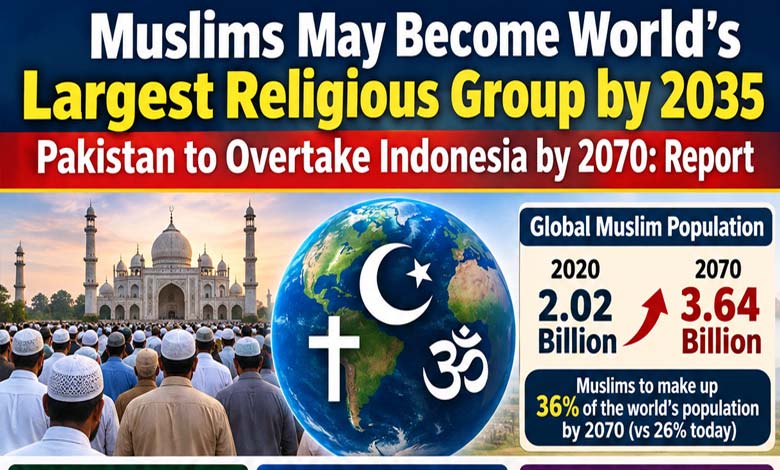
Muslims May Become World’s Largest Religious Group by 2035, Pakistan to Overtake Indonesia by 2070: Report

Hyderabad | November 19, 2026 | DeccanLive.com
A new study by the Pew Research Center suggests that Muslims could outnumber Christians by 2035, making Islam the world’s largest religious group.
According to the report, the global Muslim population is expected to increase from 2.02 billion in 2020 to 3.64 billion by 2070. Meanwhile, the number of Christians is projected to remain just below 3 billion.
Muslims are expected to make up 36 per cent of the world’s population by 2070, compared to 26 per cent today.
However, one of the biggest changes may take place thousands of miles west of South Asia, in Africa.
The centre of Christianity is gradually shifting away from Europe and the Americas towards sub-Saharan Africa. If current trends continue, more than half of the world’s Christians will live in this region by 2070. In 2020, the figure stood at 31 per cent.
The Pew report also estimates that the Democratic Republic of Congo (DR Congo) will overtake the United States in terms of Christian population.
Pakistan May Become World’s Largest Muslim Country
The new Pew Research Center study highlights the faster growth of the Muslim population compared to the Christian population across the world.
It projects that Pakistan will have the world’s largest Muslim population by 2070, while DR Congo will have more Christians than the United States.
The projections point to major demographic changes across South Asia. Pakistan is expected to overtake Indonesia as the country with the world’s largest Muslim population, while India will move to second place. Bangladesh is also expected to see a significant increase in its Muslim population.
The study examines how the religious makeup of the world could change over the next 50 years. It uses data from 201 countries and territories, covering almost the entire global population.
India to Remain Hindu-Majority Country
India is expected to remain a Hindu-majority country by a clear margin for several decades. However, its religious composition is likely to change gradually.
According to the Pew Research Center study, Hindus will make up 76 per cent of India’s population by 2070, compared to 79 per cent in 2020. Meanwhile, the Muslim share of the population is expected to rise from 15 per cent to 20 per cent.
This change is largely linked to differences in the age structure and birth rates of the two communities. Muslims in India are younger on average than Hindus and have more children.
The study examines seven religious groups between 2020 and 2070, assuming that current demographic trends continue.
Using census and survey data, researchers estimated the size and age structure of each religious group in 2020. They also considered differences in birth rates and religious conversion.
The findings place India at the centre of the changing global religious landscape.
By 2070, India is expected to have the world’s second-largest Muslim population, after Pakistan. The Muslim population in India is projected to reach around 334 million.
Pakistan is expected to overtake Indonesia, with its Muslim population reaching approximately 461 million.
However, these projections do not support some of the more dramatic claims often made about changes in India’s religious composition.
According to the report, India’s Hindu population is expected to increase by 176 million between 2020 and 2070 if current demographic trends continue.
Hindus will continue to make up more than three-quarters of the country’s population.
Why Is India’s Muslim Population Growing Faster?
Although India’s overall birth rate has fallen significantly, Muslim women still have more children on average than Hindu women.
According to Pew, this change is mainly the result of demographic momentum.
In 2020, the average age of Muslims in India was 24, compared to 29 among Hindus.
Pew estimates that between 2025 and 2030, Muslim women in India will have an average of 2.3 children, while the average for Hindu women will be 1.8.
Stephanie Kramer of the Pew Research Center told the Media that India’s religious changes are expected to be driven almost entirely by long-standing demographic differences between Hindus and Muslims.
She said Muslims are younger on average and have higher birth rates.
Kramer also pointed out that the gap in birth rates has reduced considerably.
In 1992, the difference was more than one child per woman. In recent years, it has fallen to around half a child and is expected to become even smaller.
However, the Hindu fertility rate has already fallen below the replacement level, while the Muslim fertility rate is expected to remain above that level for the next two decades.
The replacement fertility rate is the average number of children a woman needs to have for a population to remain stable over time, without considering migration.
Experts Say Birth Rate Gap Will Continue to Narrow
Indian demographer K.S. James of Princeton University said the projections were not surprising.
Speaking to the Media, he said the difference in birth rates between Muslims and Hindus was well established. This means the Muslim population is likely to grow relatively faster over the next few decades.
However, fertility rates are falling across all religious communities, and the gap is expected to become smaller.
“Eventually, they will come closer,” he said.
James added that the projections do not point to any dramatic change in India’s demographic direction.
Demographers have rejected claims, often promoted by Hindu right-wing groups, that Muslims will eventually outnumber Hindus in India.
Experts say there is no evidence of any major religious conversion driving demographic changes in the country. They also say the projections do not support such alarmist scenarios.
South Asia to See Major Changes in Muslim Population
The wider picture across South Asia is equally important.
By 2070, Pakistan’s Muslim population is expected to cross 461 million, making it the country with the world’s largest Muslim population.
India will rank second, with around 334 million Muslims, while Bangladesh’s Muslim population is projected to reach 218 million.
Meanwhile, India and Nepal are expected to remain the world’s only Hindu-majority countries.
These regional changes are part of a much bigger global trend.
Christianity’s Centre Shifting Towards Africa
According to the report, Europe is expected to see the biggest decline in its share of the global Christian population.
If current trends continue, only 11 per cent of the world’s Christians will live in Europe by 2070, compared to 22 per cent in 2020.
The United States is expected to lose its Christian-majority status by 2065. However, Christians are still projected to remain the country’s largest religious group in 2070.
The growing number of people who do not identify with any religion is another major factor behind these changes.
By 2070, people with no religious affiliation are expected to become the majority in the United Kingdom and France.
South Korea is also likely to follow a similar path.
However, the global share of people with no religious affiliation is projected to fall from 24 per cent to 17 per cent.
This decline is largely due to China’s shrinking population. Nearly two-thirds of the world’s religiously unaffiliated population currently lives in China.
According to the report, China’s expected population decline will offset the growth of non-religious populations in other countries.
US May Have the World’s Fifth-Largest Hindu Population
Some other unexpected changes are also projected by 2070.
The United States is expected to become the country with the world’s fifth-largest Hindu population, mainly due to migration.
Similarly, people with no religious affiliation are expected to outnumber Christians in Australia and become the country’s largest group.
On the other hand, Buddhism is likely to face demographic challenges.
The number of Buddhists in China, Japan and South Korea is expected to fall by more than half. This reflects the ageing and shrinking populations of East Asia.
Laos and Mongolia could also lose their status as Buddhist-majority countries.
Pew Study Comes With Important Limitations
The projections come with several important qualifications.
They are demographic estimates, not predictions of everything that may happen in the future.
Pew assumes that current trends in birth rates, migration and religious switching will continue.
The report also acknowledges that several events could affect the size of religious groups. These include wars, natural disasters, epidemics and changes in economic or social conditions. Such events have not been included in the analysis.
For India, the researchers also had to estimate the country’s religious composition in 2020 using data from the 2011 Census, as the next census had been delayed.
Despite these limitations, the overall direction of change is clear.
South Asia will continue to play a major role in the world’s religious landscape, not only because of India’s large Hindu population but also because of the growing Muslim populations across the region.
Africa will become increasingly important in shaping the future of Christianity, while Europe and parts of East Asia are expected to become less religious.
By 2070, the world’s religious landscape could look very different. These changes are likely to be driven more by differences in birth rates, deaths and migration than by people changing their religion.