
Sonia Gandhi’s Memoir ‘Belonging’ Breaks Records, Sells Over 2 Lakh Copies in Just One Week, Earns Around Rs 20 Crore

Sonia Gandhi’s Book Creates a Buzz in the Publishing World
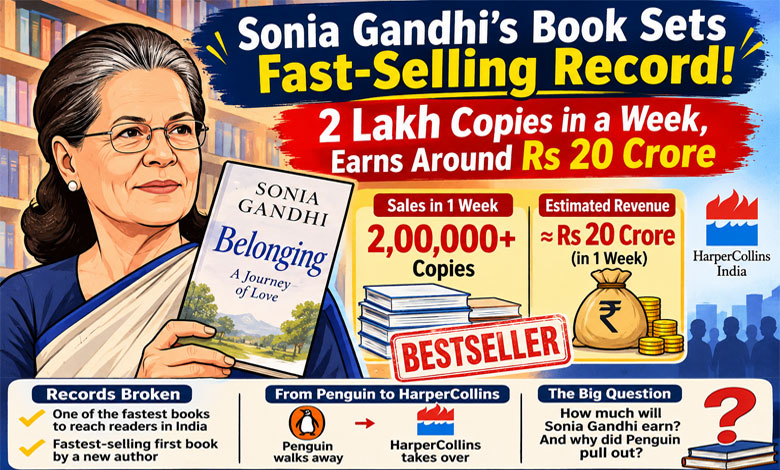
Sonia Gandhi’s book Belonging: A Journey of Love, released on November 10, has reportedly broken several sales records.
According to its publisher, HarperCollins India, more than 2 lakh copies of the book have been sold so far. This means the book has reportedly generated sales worth around Rs 20 crore in just one week.
How much of this money will go to Sonia Gandhi and how much will the publisher earn? What challenges did the book face before publication? Let’s understand the details in today’s explainer.
Question 1: What Records Has Sonia Gandhi’s Book Set?
In India, organisations such as the Federation of Indian Publishers (FIP) publish reports related to book sales. However, no such official report has been released for Sonia Gandhi’s book so far. In most cases, publishers themselves announce sales figures.
At the book’s launch event in Delhi on November 16, Ananth Padmanabhan, CEO of HarperCollins India, claimed that the book had set two major records for fast sales.
1. One of the Fastest Books to Reach Readers in India
According to Ananth Padmanabhan, more than 15,000 copies of the book were delivered within just 10 minutes of sales opening at 10 AM on November 10.
He said this made it one of the fastest books to reach readers in India. Quick-commerce platforms such as Blinkit were used to deliver the copies.
Before this, J.K. Rowling’s Harry Potter and the Deathly Hallows was widely regarded as one of India’s fastest-selling books. More than one lakh copies were sold on its first day of release in 2007. However, quick-commerce delivery services were not available at that time.
Abhinav Bamhi, an old bookseller in Delhi’s Khan Market, said, “After the Harry Potter book in 2007, this is the first time we have seen such excitement among readers for a book.”
2. Fastest-Selling First Book by a New Author
This is Sonia Gandhi’s first book. According to HarperCollins, more than 2 lakh copies were sold within one week of its release.
Before this, the record was held by Sachin Tendulkar’s autobiography, Playing It My Way.
Sales of Sachin’s book began on November 6, 2014, and around 1.5 lakh copies were pre-ordered. By the launch event on November 25, total sales had reached 2 lakh copies.
It was Sachin Tendulkar’s first book, which he co-wrote with sports journalist Boria Majumdar.
Sachin’s book was priced at Rs 899, while Sonia Gandhi’s book is being sold online for around Rs 849. However, its printed maximum retail price (MRP) is Rs 1,299.
Ananth Padmanabhan also said that Sonia Gandhi’s book had become one of the fastest-selling non-fiction books and memoirs in the country.
Sachin Tendulkar’s book had also set fast-sales records in both fiction and non-fiction categories.
Question 2: How Much Money Will Sonia Gandhi Earn from the Book?
There is no exact answer because publishers and authors usually do not disclose their royalty agreements.
However, by understanding how the publishing business works, we can estimate how much an author may earn from book sales.
Before a book reaches readers, the publisher handles editing, designing and proofreading. After publication, the book generally passes through four stages before reaching customers:
1. Book Distributor’s Share: 40% to 55%
Book distributors handle the storage, distribution network and return of unsold books.
According to Iterative International Publishers (IIP Books), distributors may receive around 40% to 55% of a book’s price.
2. Retailers and Online Platforms: 20% to 35%
Bookshops and online platforms such as Amazon and Blinkit sell books directly to customers.
Their share generally ranges between 20% and 35% of the book’s price.
In some cases, distributors also work as retailers. Some online platforms may additionally charge distributors for promoting books.
Nowadays, some publishers focus mainly on online sales to reduce the costs involved in distribution and retailing.
3. Publisher’s Share: 15% to 30%
After deducting the distributor’s and retailer’s margins, the remaining amount goes to the publisher.
The publisher has to use this money to cover printing, marketing, book launches and other expenses.
The publisher also pays the author’s share from this amount. This payment is known as royalty.
4. Author’s Royalty: Around 15% to 30% of the Publisher’s Share
According to IIP Books, many authors are surprised to learn that their royalty is often calculated on the amount left after distribution costs, rather than on the book’s full MRP.
For example, if a book costs Rs 300 and the distributor takes Rs 150, the publisher is left with Rs 150.
If the author receives a royalty of 10% on this remaining amount, the author will earn only Rs 15 per copy.
This means the author’s actual earnings will be just 5% of the book’s original price.
How Does Royalty Differ for New and Established Authors?
Royalty rates can vary depending on the agreement between the author, publisher and distributor.
- New authors generally receive a royalty of around 10% to 15% on hardcover editions.
- For paperback editions with lighter covers, the royalty is usually around 10%.
- Many first-time authors do not receive any advance payment.
- Popular and established authors may receive an advance payment under their publishing contracts, along with higher royalty rates.
Large publishing houses such as HarperCollins usually print a large number of copies in one batch. This reduces the printing cost per book.
On the other hand, publishers may print fewer copies of books by new authors. This increases the printing cost per copy and can affect the royalty offered to the author.
Self-Publishing: Another Way for Authors to Earn
Online platforms such as Amazon Kindle also offer self-publishing facilities.
Under this system, authors can publish their books independently without depending on a traditional publishing house.
They may receive 30% or even more of the revenue, depending on the platform and the agreement.
However, authors have to manage important tasks such as book designing, marketing and promotion themselves.
How Much Could Sonia Gandhi Earn?
There is no official information about the royalty percentage Sonia Gandhi will receive or the exact amount she will earn from the book.
However, an estimate can be made using the available sales figures and prices.
The printed MRP of the book in India is Rs 1,299, while it is available on online platforms for around Rs 849.
Taking the average of these two prices, the estimated selling price comes to around Rs 1,074 per copy.
Based on sales of 2 lakh copies, the total estimated sales value comes to approximately Rs 21.48 crore, or around Rs 20 crore.
If Sonia Gandhi receives a royalty of 10%, her earnings could be around Rs 2 crore.
Apart from India, the book has also been published by Alfred A. Knopf in the United States and William Collins in the United Kingdom. However, official sales figures from these countries have not been released.
Question 3: What Problems Did Sonia Gandhi’s Book Face Before Publication?
Sonia Gandhi’s book was originally scheduled to be published in India by Penguin Random House India.
On August 18, 2026, Alfred A. Knopf, an imprint of Penguin, announced that the book would be released worldwide on November 10.
However, on October 31, 2026, Penguin suddenly announced that it would not publish the book in India.
The publisher said that the decision was taken because of a disagreement between the author and the publisher over a particular issue.
Penguin said that both sides had agreed to some changes and the publisher had also accepted certain suggestions from the author. However, they could not reach an agreement on one issue in the end.
Congress Leaders Alleged Political Pressure
Congress leaders and several others alleged that Penguin had refused to publish the book because of political pressure.
Ashok Gehlot, former Rajasthan Chief Minister, claimed that Penguin was under pressure to remove certain portions of the book relating to Prime Minister Narendra Modi, the RSS and China’s occupation of Indian territory.
The English newspaper The Hindu, quoting its sources, also reported that the disagreement may have been related to these issues.
However, Penguin India denied that any external pressure was behind its decision to withdraw from the project.
What Did Penguin Say?
Penguin India spokesperson Pallavi Narayan said that certain misunderstandings needed to be cleared.
She said, “We were very excited to publish this book because it was something we had worked hard to acquire. The publication was stopped because one issue remained unresolved during the normal editorial process.”
Penguin also explained that a publisher has a responsibility to critically assess a manuscript, raise questions, offer suggestions and take independent editorial decisions.
According to the publisher, Sonia Gandhi’s team itself decided not to continue working with Penguin, and the publisher respected that decision.
Penguin further said that the contents of the book were confidential and that no external pressure was involved in its decision.
HarperCollins Steps In
After Penguin withdrew from the project, HarperCollins announced on November 4 that it would publish Sonia Gandhi’s book in India.
When asked how HarperCollins entered the picture, CEO Ananth Padmanabhan said that he would share the story on another occasion.
The book was subsequently released on November 10 and reportedly sold more than 2 lakh copies within its first week, making it one of the major publishing success stories of the year.