

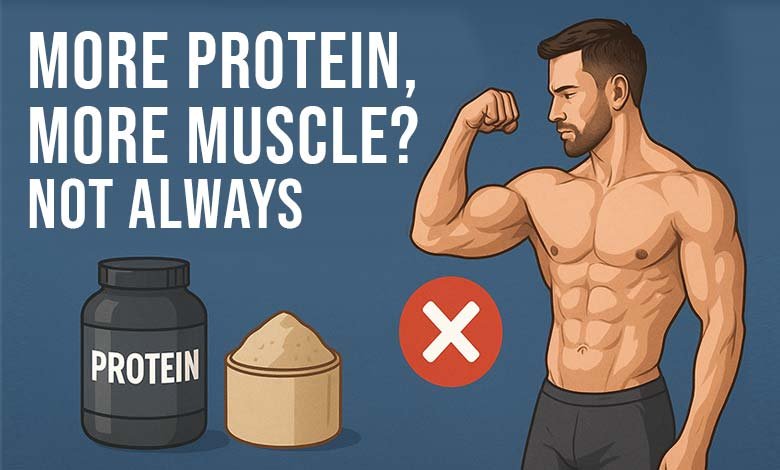
More Protein, More Muscle? Not Always

Dr. Syed Mutiullah Hussaini
From body builders to the social media health influencers everyone has spoken about protein when you walk into gyms today you’ll constantly hear a word more than weights is protein. It became the modern symbol for healthy diet and fitness. But somewhere between gym advisers social media influencers and pseudo health advisers and supplement marketing the real science behind protein is blurred.
Is protein really a magical key to muscle growth or a clever marketing strategy packed with myths? As a doctor we were taught that nutrition is biology not just branding. Understanding how much protein we really need is an important question to make a barrier between marketing and nutritional requirement. Why people overrate protein? Protein has long been marketed as a magical macronutrient more protein means more muscle is the narrative often used by health influencers this myth is a clever marketing rather than metabolic sciences. Several scientists claim that the overuse of protein supplements or high dietary protein intake could cause disorders to human health. [1]
In a metabolic study an increase in protein intake from about 47 to 112 g caused an increase in urinary calcium and a decrease in calcium retention. The data indicated that protein-induced hypercalciuria was due to an elevation in glomerular filtration rate and a lower fractional renal tubular reabsorption of calcium, the latter of which caused by the increased acid load on the renal tubular cells. [2]
Why this exist
- Marketing manipulation
The supplement company has been grown into multi billion dollar empires around the high protein labels selling the shakes bars pancakes even cereals, The consumer relates with protein rich with healthy despite its high sugar content For example a 30gm protein bar contains 15gm sugar but nutritionally it similar to candy bar with extra whey. - Social media echo
The body building world popularized 1g of protein 0.5kg body weight but they forgot that this ratio is for elite athletes not for sedentary individuals. The current recommended dietary allowance (RDA) for protein is 0.8 g protein/kg body weight/day for adults (for children 1.5 g protein/kg body weight/day, and for adolescents 1.0 g protein/kg body weight/day). [3] - Fear of muscles loss (Catagelophobia)
There is a constant fear in gym goers that missing a protein dose will trigger muscle breakdown. in reality muscle catabolism occurs primarily under severe calorie restriction or illness. - Simple bias
People easily say protein is equal to muscle but the real biology is multifunctional muscle growth also requires progressive overload hormonal balance sleep and total caloric sufficiency
Extra protein is not used efficiently by the body and may impose a metabolic burden on the bones, kidneys, and liver. Moreover, high-protein/high-meat diets may also be associated with increased risk for coronary heart disease due to intakes of saturated fat and cholesterol or even cancer. [4]
Optimal protein utilization – how much really needed
The human body is so efficient that it can maintain its biochemical system; it uses what is required and stores or dispose the rest. In this section lets discuss about optimal protein intake which resolves around balance not abundance Proteins aren’t just for muscle growth. It serve as structural support, biochemical catalysts, hormones, enzymes, building blocks, and initiators of cellular death however its intake efficiency depends on dose distribution timing etc.
How much protein actually needed
The current international Recommended Dietary Allowance (RDA) for protein is 0.8 g per kg of body weight (bw), regardless of age [5] or physical activity levels. However, depending on lifestyle (e.g., more physical activity, older age, growth/pregnancy), higher amounts are often recommended.
Although some research suggests that protein requirements may actually decrease during training due to biological adaptations that improve net protein retention. [6]
For old age peoples International PROT-AGE Study Group [7] and European Society for Clinical Nutrition and Metabolism (ESPEN) [8] concluded that daily protein requirement of healthy individuals over 65 years is 1.0–1.2 g protein/kg/bw.A further increase is recommended for individuals with acute or chronic illnesses (1.2–1.5 g protein/kg/bw) and severe illnesses, injuries, or malnutrition (2.0 protein g/kg/bw). [9]
For endurance exercisers , recommended protein intakes range from 1.0 g/kg to 1.6 g/kg per day [10] depending on the intensity and duration of the endurance exercise, as well as the training status of the individual.
Common myths
- More protein = more muscle
Reality is training intensity and caloric adequacy are bigger drivers - Skipping proteins for few hours causes muscle loss
Reality is muscle protein synthesis fluctuates naturally what really matters is daily intake
In summary
To sum up with thoughts between marketing and real sciences, protein is essential, not magical. The misconception that more protein is equal to more muscle is majorly a marketing gimmick. In reality protein is used in various functions. more than threshold intake is no use.
Research papers clearly state that:
- The average adult needs only 0.8 g/kg/day,
- Active individuals endurance or resistance trainers athletes may need up to 1.6 g/kg/day,
- Elderly and clinically ill individuals may benefit from slightly higher intake (1.2–2.0 g/kg/day),
while anything beyond this will diminish returns and its just a burden to renal and hepatic metabolism
In simple terms protein is an important nutrient not a trophy
Balance diets will be useful for sustain healthy life not just protein
The future of nutrition lies not in chasing macronutrients but eating healthy and balanced diet as per the requirement of body.
My purpose to write this article is to promote evidence into awareness not fear, to create a barrier between marketing and scientific needs.

Author: Dr. Syed Mutiullah Hussaini
References:
- Kafatos A, Hatzis C. Clinical Nutrition for Medical Students. University of Crete; 2008. [Google Scholar]
- Schuette SA, Zemel MB, Linkswiler HM. Studies on the mechanism of protein-induced hypercalciuria in older men and women. Journal of Nutrition. 1980;110(2):305–315. doi: 10.1093/jn/110.2.305. [DOI] [PubMed] [Google Scholar]
- Kafatos A, Hatzis C. Clinical Nutrition for Medical Students. University of Crete; 2008. [Google Scholar]
- St. Jeor ST, Howard BV, Prewitt TE, Bovee V, Bazzarre T, Eckel RH. Dietary protein and weight reduction: a statement for healthcare professionals from the nutrition committee of the council on nutrition, physical activity, and metabolism of the American heart association. Circulation. 2001;104(15):1869–1874. doi: 10.1161/hc4001.096152. [DOI] [PubMed] [Google Scholar]
- Food and Nutrition Board (FNB) of the Institute of Medicine . Dietary Reference Intakes for Energy, Carbohydrate, Fibre, Fat, Fatty Acids, Cholesterol, Protein and Amino Acids (Macronutrients) The National Academies Press; Washington, DC, USA: 2005. [Google Scholar]
- Rennie MJ, Tipton KD. Protein and amino acid metabolism during and after exercise and the effects of nutrition. Annu Rev Nutr. 2000;20:457–483. doi: 10.1146/annurev.nutr.20.1.457. [DOI] [PubMed] [Google Scholar]
- Bauer J., Biolo G., Cederholm T., Cesari M., Cruz-Jentoft A.J., Morley J.E., Phillips S., Sieber C., Stehle P., Teta D., et al. Evidence-based recommendations for optimal dietary protein intake in older people: A position paper from the PROT-AGE Study Group. J. Am. Med. Dir. Assoc. 2013;14:542–559. doi: 10.1016/j.jamda.2013.05.021. [DOI] [PubMed] [Google Scholar]
- Deutz N.E., Bauer J.M., Barazzoni R., Biolo G., Boirie Y., Bosy-Westphal A., Cederholm T., Cruz-Jentoft A., Krznariç Z., Nair K.S., et al. Protein intake and exercise for optimal muscle function with ageing: Recommendations from the ESPEN Expert Group. Clin. Nutr. 2014;33:929–936. doi: 10.1016/j.clnu.2014.04.007. [DOI] [PMC free article] [PubMed] [Google Scholar]
- Bauer J., Biolo G., Cederholm T., Cesari M., Cruz-Jentoft A.J., Morley J.E., Phillips S., Sieber C., Stehle P., Teta D., et al. Evidence-based recommendations for optimal dietary protein intake in older people: A position paper from the PROT-AGE Study Group. J. Am. Med. Dir. Assoc. 2013;14:542–559. doi: 10.1016/j.jamda.2013.05.021. [DOI] [PubMed] [Google Scholar]
- Lemon PW. Beyond the zone: protein needs of active individuals. J Am Coll Nutr. 2000;19:513S–521S. doi: 10.1080/07315724.2000.10718974. [DOI] [PubMed] [Google Scholar]